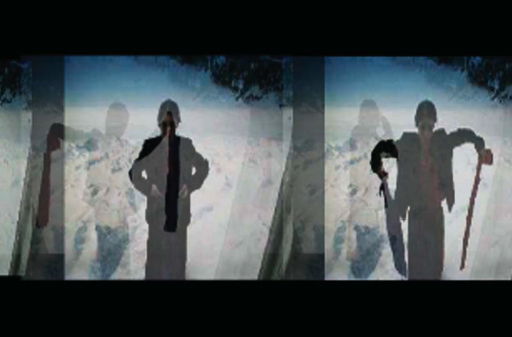
Sequences/Artists/Babel/Turnbaby
In 1913 Anton Bragaglia contrasted his notion of a futurist ‘photodynamism’ with the contemporary methods of cinematography and chronophotography: “We are not interested in the precise reconstruction of movement, which has already been broken up and analysed. We are involved only in the area of movement which produces sensation.” Photodynamism records images in a distorted state “since images themselves are inevitably transformed in movement”.
Babel sees “Turnbaby” as a form of 'videodynamism'. His work is also not concerned with perfect reproductions or the moment. As Bragaglia went on to say: "our aim is to make a determined move away from reality, since cinematography, photography and chronophotography already exist to deal with mechanically precise and cold reproduction." Babel intends the viewer to see the images devolve into broken idealised forms. His work also depends on user interaction: without this, the images eventually fade away.
Babel’s intention is to capture something essential, to represent the motion itself, its form and volume in space across time. Videodynamism takes account of both the motion of the subject and the motion of the screen upon which the subject is depicted. This may represent the movement of the eye around its visual field, as well as the dynamism of screens and windows in a digital environment.